
| ||||
| • Hauptseite ~ main page | • Sammlung ~ collection | • FAQ | • Kontakt ~ contact | |
In 2021, my Lubor Fiedler project began with a series of articles in the magazine Magie. For three issues, we commemorated Lubor Fiedler and celebrated his contributions to the art of magic. Below you can read an english translation of these texts in their original form at the time.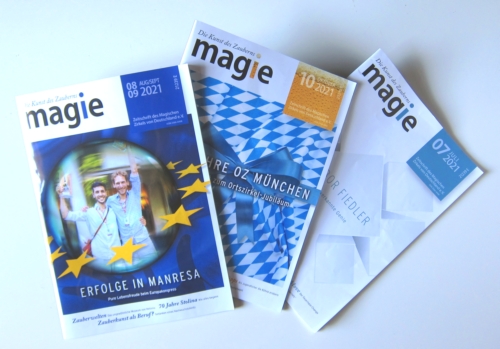 Lubor Fiedler – inventing to grow
Lubor Fiedler – inventing to understand Lubor Fiedler – inventing to create In Illustrious Company A Gyro Gearloose of Magic Encounters with Lubor Fiedler How we managed to prevent the Vienna fire brigade from being called at the last moment – and yet still got 'kicked out' of the venue … An “Expedition” to Lubor Fiedler deutsch (Magie 7/21, page 350: “Ruhm, Ehre und dennoch unbeachtet”) Lubor Fiedler – inventing to growFranz Kaslatter LUBOR FIEDLER (∗ 26.4.1933, † 20.8.2014) distinguished himself from other creative magicians by his admirable courage to explore technical fringes as an inventor. He worked on certain trick principles, which others would have long abandoned as hopeless, with incredible persistence until they finally resulted in a usable magic trick, in many cases even a genuinely ingenious one. He was born in Brno and emigrated to Austria in 1967, where he lived for over 30 years before returning in his later years to his Czech hometown. For a long time I have been collecting everything about LUBOR FIEDLER (see “www.luborfiedler.at”!) and a few years ago, in the course of systematically maintaining my collection, I discovered to my utmost astonishment that despite his great fame during his lifetime, LUBOR FIEDLER appeared in the MZvD magazine "Magie" only as an occasional footnote, usually when someone wanted to flaunt their acquaintance with him, mentioned him casually in the course of a completely different topic, copied one of his tricks, or needed a metaphorical reference for the typical inventor of magic tricks. The only Magie article about LUBOR FIEDLER in all these years remains to this day his obituary in issue 10/2014 on page 465, written by JENS-UWE GÜNZEL, who pointedly notes: “Above all in recent years, he was honoured by many magical societies around the world with awards and distinctions, as well as honorary titles.” Well, except by the MZvD (Magic Circle of Germany), right? 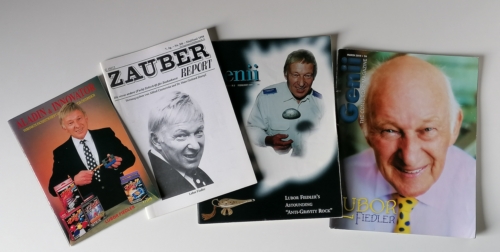 But can that really be true? At first, I didn't want to believe it and would have really liked to be wrong about it. So I turned to the editor-in-chief, MICHELLE SPILLNER, hoping she might be able to pull an old forgotten magic magazine out of her sleeve that contained an interview with Lubor Fiedler or a feature about him, possibly even with him on the cover. To my dismay, I was unfortunately completely right: such a magic magazine did not exist. So, for better or worse, I had to face the reality, and before I could fall too deeply into self-pity, MICHELLE had already tasked me with writing a series of articles about LUBOR FIEDLER. In other words, she promptly conjured up a future issue out of her sleeve – which you are now holding in your hands.
In this three-part series, I will only publish private information about LUBOR FIEDLER that has already been published elsewhere out of respect for his privacy, and out of respect for his intellectual property, I will also not focus on explaining his magic tricks. What I want to concentrate on thematically is the invention of magic tricks itself. I want to illustrate its purpose and meaning, its usefulness and value, as well as its challenges and limitations, using LUBOR FIEDLER as an example. I would appreciate it if you do not dwell on the words I use to express myself, but rather on what I am trying to convey to you. For example, when considering the technique of tricks, it is initially essential to clearly distinguish between trick principle, ploy, trick and routine, which build upon each other in the technical development process. And please do not be disturbed by my terminology here, although one could just as well use other words for the same concepts, such as principle, effect, application and performance, I have chosen the above. Keep in mind that we are dealing with such an under-established topic that, for instance, it does not even appear in the “Wörterbuch der Zauberkunst” (Dictionary of Magic, HUBERT WEDLER, 1990). Notably: it is not just the word “invention”, but the entire topic that is absent there, and such words as “talent, idea, inventor, genius, giftedness, creation, creativity, patent, plagiarism, creator, talent, author” are completely in vain to search for in this official magic vocabulary. What true invention is really about is the trick principle. MARK SETTEDUCATI, one of LUBOR FIEDLER's best friends, emphasises this very important aspect: “Most magic inventors aren't really inventors; myself included. We are designers. We take known principles and ideas, put them together and make a trick out of them. Only by accident do we occasionally stumble upon a new principle. Lubor is the only inventor that can create new principles on demand. He creates new ideas or takes a non-magic concept and creates a magical principle from it. Lubor has invented more than 70 new principles in magic, more than any magic inventor who has ever lived.” (Genii, 3/2014, page 69) Therefore, one should clearly distinguish between inventing and designing, which most “creators” of magic tricks limit themselves to, and in whose realm the excuse of idea theft “... nothing new under the sun” circulates for good reason. However, this saying does not apply to true inventors, who by definition actually create something new.  Marketing a new trick concept as such, especially if it is patentable prior art, would be quite risky from a business perspective. Therefore, it is usually packaged into a performance piece that represents new, less controversial intellectual property that can be traded. However, between the trick principle and the trick lies another essential development step that is often overlooked: the ploy. For many magicians, the word 'ploy' has no distinct meaning; they rather use it as a shortened synonym for the trick principle.
However, the ploy itself is neither of these, but rather a specific optional application of an underlying trick principle and a significant optional component of a magic trick. The same trick principle can enable several different ploys, and an unlimited number of different performances can be based on the same ploy. To demonstrate a trick principle in its function, a trick enabled by it is needed. To market a trick principle, a performance based on it is usually designed. Therefore, the actual work of an inventor ends at the latest with the finished trick, while a 'creator' might additionally develop a routine. A good example of this developmental structure is “Fantastic Knot” by PAVEL POMEZNY, which became world-famous under various product names through DARYL MARTINEZ and is nowadays marketed by GREGORY WILSON. The routine consists of several tricks, one of which is the transfer of the knot from one rope to another. This one trick, in turn, is based on several ploys, one of which is the disappearance of the knot from the first rope, and this ploy is made possible by the trick principle of the false knot, which in a magician's application involves a loop stitch as known from crocheting. I hope that with my previous explanations I have made it clear enough that the true purpose of inventing is to provide new trick principles to expand the repertoire of ploys for the creation of new tricks and routines. As an example of the complete development process, I have just preferred a PAVEL trick because LUBOR FIEDLER's rich body of work usually concerns only the fundamentally important first two phases, where his genius was truly at home and provided us with his most wonderful inventions. All the more annoying to him was the commercial necessity to turn his inventions into products beyond this development stage, as he suggests quite emphatically under the title “Die Gedankenwelt eines Zaubertrick-Erfinders” ('The Thought World of a Magic Trick Inventor') in Aladin 1/1998 on page 14: “Imagine a music composer who buys a record press (injection moulding machine!), produces records with his own music, and then offers them on the market to access his money. Would you pity him? Does it seem strange to you? Well, this case is purely fictional, but – in the magic industry, we have something similar! The absolute majority of magic trick inventors must produce and sell their inventions themselves if they want to make a living from them. In other words, they must at least also be the operators of a production company, which consequently leaves them little time for inventing. A vicious circle! (…) That I myself may have been able to escape this dilemma, I owe to the New Yorker Mark Setteducati.” In 1990, MARK SETTEDUCATI established personal contact with LUBOR FIEDLER as a long-time admirer, which quickly developed into a close friendship and creative partnership. The following quotes are all from Genii (3/2014, pages 72 and following), where MARK SETTEDUCATI recounts: “When I met him, Lubor was spending about 80 percent of his time performing at schools and resorts in Austria, manufacturing and selling his tricks, and only 20 pecent inventing. I really thought that was absurd. With his mind, he should have been spending all of his time inventing.” MARK SETTEDUCATI was well-versed in the toy and magic kit industry, introduced LUBOR FIEDLER to the company Tenyo, and advised him on the type of magic tricks he should invent to be suitable for Tenyo. Lubor Fiedler somewhat exaggerates this labour-intensive collaborative process: “Mark tells me 'No' all the time. He says 'No chemicals, no electronics, no liquids, no pieces that need replacement, no playing cards – there are too many of those already – no tricks that only work on TV, no sleight of hand, no complicated procedure, no bad angles.' I ask him 'What's left?'” The answer meanwhile has become a Tenyo magic history: Parabox (1993), Invisible Zone (1995), Krazy Keys (1996), Impossible Pen (1997), Antigravity Rock (1998), Phantom Clock (1999), Blue Crystal (2000), 4-D Surprise (2010), The Third Eye (2011), Flying Carpet (2011), Card Surgery (2012), Ghost Card (2013) and Security Lock (2014). 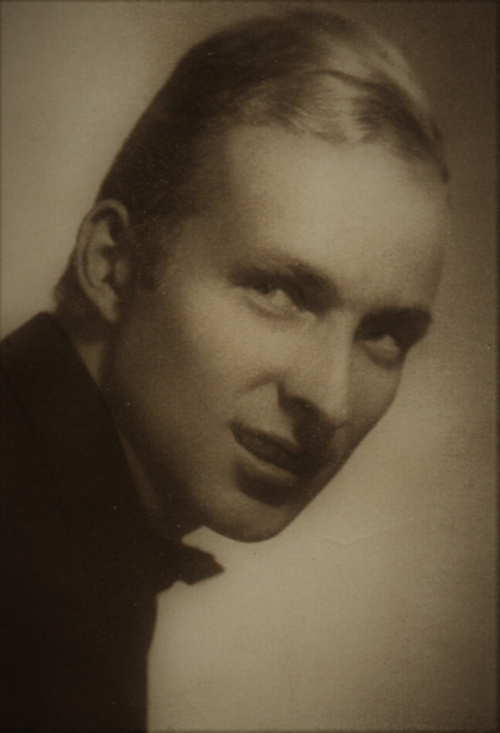 Although a trick principle can only be demonstrated in its function through a magic trick and most inventors communicate only through tricks for the reasons mentioned, the real achievement of the true inventor is the trick principle. Nevertheless, a majority of magicians behave as if they cannot see the forest for the trees when evaluating inventions: they are relatively blind to the importance of the fact that a magic trick consists, among other things, of trick principles and ploys, and for practical reasons they mostly only assess the usability of finished tricks and the fun factor of the secret, but not an 'unfinished trick', which a trick principle appears to be in their eyes. Therefore, the commercial and social success of the inventor almost exclusively arises from and is measured by the creation of new tricks, as I have just exemplarily listed for you using the Tenyo products of LUBOR FIEDLER.
As the purpose of inventing, however, I have mentioned to you the creation of new trick principles and pointed out the fundamental difference from the ploys enabled by them and the tricks based on them. It is as if most people, in their perhaps philosophically half-full glass, only want to acknowledge water, without caring that drinking water consists of different molecules, which consist of atoms, which consist of elementary particles, and so on. When they drink their water, they are drinking alongside and with the water molecules also carbonic acid, carbonates or sulphates as well as atoms such as calcium, magnesium, sodium, oxygen, hydrogen and their elementary particles. With this comparison, I do not intend to deny that water refreshes and quenches thirst even without particle physics, but beyond this purely practical and pleasure-oriented assessment, point out that you must be willing to look beneath the level of development of a magic trick so that you are able to perceive and appreciate the true achievement of an inventor. Lubor Fiedler tidies up the apartment and discovers a trick principle there LUBOR FIEDLER had the idea for one of his most famous inventions at the age of 33 while trying to create a bit more space in his small apartment in Brno. He noticed that two entirely identical boxes (if they have the appropriate proportions) can actually be stacked inside each other, and it immediately became clear to him that this trick principle allows the boxes to be stacked the other way around, with the seemingly larger box inside. This ploy – along with an optically particularly suitable design of the boxes for trick purposes – forms the basis of his trick “Lubor's Die”, which was released by the Supreme Magic Company after this trick caused a sensation at the 1970 FISM Congress in Amsterdam and made LUBOR FIEDLER world-famous. To avoid confusion, after many fans also used the name 'Lubor Die' for Lubor Fiedler's 'Automat 2' die, it is now marketed as 'Die-a-Bolic' and the trick with the boxes is usually referred to as 'Gozinta Box'. Under the name 'Parabox' (product number T-161), the same trick marked the beginning of a successful collaboration with Tenyo. LUBOR FIEDLER gained honour and fame as an inventor, but only rarely received material compensation. The variety of different Gozinta boxes has meanwhile become almost unmanageable, for example the “In-n-Outer Box” by Royal Magic (1981) or the “In & Out Boxes” by the company Empire (2005). The trick principle of the Gozinta boxes enabled other magicians to develop further ploys on which new tricks are based, such as the “Driebeck Die”, marketed by BOB DRIEBEEK in 1975 through KEN BROOKE, a stage illusion by Dick Zimmerman, performed on television by DOUG HENNING in 1981 with RICKY SCHRÖDER and MARIE OSMOND, or the card routine “My Mind Box” by KENTON KNEPPER from 2006. A very interesting e-book entitled “The Box Goes-In-Da Box” was published by PETER PREVOS in 2016. Just as a Gozinta box seemingly grows a little for us when we need it, so the art of magic actually grows with each new trick principle that is available to us when we need it – and LUBOR FIEDLER contributed a large part to this. top deutsch  (Magie 8+9/21, page 434: “Die unsichtbare Wirkungswelt des kreativen Geistes”)
Lubor Fiedler – inventing to understandFranz Kaslatter In Austria, the protection of professional titles in official language use is stricter than in Germany. For example, not everyone who has once climbed onto a stage is allowed to seriously call themselves an “actor”; only those who have completed the corresponding training with a diploma are permitted. Likewise, beyond the figurative comparison, someone is not already an enthusiastic “singer” just because they like to sing in the shower, a gifted “cook” simply because they can prepare food themselves, or a passionate “dancer” just because they occasionally enjoy dancing. It is for this reason that I do not call LUBOR FIEDLER a researcher, and he himself has largely refrained from it as well. Nevertheless, for example in “Magische Fantasien” (“Magical Fantasies”, 1978) on page 86, he hints: “That magic is not only art, entertainment or a hobby, but also a science, requires no further justification among magicians. ” And there on page 90 he even slips it out literally, which occurs very rarely in all his writings: “The following idea also belongs to the field of my research, …” LUBOR FIEDLER systematically examined the suitability of new scientific and technical developments for their respective potential as a trick principle. He conducted intensive experimental series for numerous inventions to explore ideal timings, dosages, force ratios and material compositions and to better understand their options and regularities, which, however, did not automatically mean that this understanding was transferred to the customers when marketing such tricks without significant loss of information, who believed they don't had to follow the instructions exactly. A good example of this is LUBOR FIEDLER's “Fingerblitz”, also known by the names “Pyroflash”, “Handblitz&lrdquo; and “Knall-Blitz-Pulver”. It is a special effect that produces a bang, a flash and some smoke with a snap in the bare hand. It is important to use only a very small amount of the required chemicals, to ensure dry fingers, and that after snapping, one does not rest the fingers on the thumb pad but immediately stretches them again so that the explosion occurs in the air rather than in the fist. When LUBOR FIEDLER toured the USA with his lecture in 1981, he also presented the “Fingerblitz” there. MAX MAVEN recalls this lecture at the Magic Castle: “His lecture was given before a packed audience in the Palace of Mystery. Among the miracles shown during the first half was a method for causing a burst of light and sound from an apparently empty hand. The process involved two chemical powders, one black and one red. A small quantity of black was smeared on the thumb, and a small bit of the red was set on the middle finger tip. What you had done was, essentially, to convert your finger and thumb into a match head and a striking surface. When you snapped your fingers, the powders would combust, producing a small explosion that looked and sounded fantastic – a great way to emphasize the magic moment in almost any routine. Lubor had the powders for sale, in pairs of small plastic bags attached to a cardboard backing piece. Not surprisingly, as soon as the intermission began, most of the attendees ran to the sales table to get some. And by the time the intermission was over, 20 minutes later, the audience was filled with the sound of soft moaning, because almost every purchaser had managed to burn himself” (Genii 3/2014, page 71) In 1978, full-page advertisements appeared in relevant magic magazines, promoting the then newly released book 'Magische Fantasien' (1978, 94 pages) with the following words: “HANNS FRIEDRICH: 'Magische Fantasien' the life's work of LUBOR FIEDLER. Completed shortly before the death of HANNS FRIEDRICH by him, but only released today. “ Noteworthy is the term life's work in this context, because LUBOR FIEDLER was not at the end of his career at that time, but rather in the second bloom of his creative output. As evidence of “such inspirations and magician's fantasies” (see below!), the tricks “A House Disappears” (page 18), “Face Change” (page 28) and “Trance Mirror” (page 66) are found in “Magical Fantasies”. By this time, LUBOR FIEDLER had, of course, already invented as much as corresponds to the usual life's work of a very productive inventor, so that his achievement could arguably be considered a life's work in terms of scope, and this word as a measure of quantity. For this reason, one might not have even conceived that a large part of his inventions was yet to come. For these and other reasons, the claim to publish a complete work with “Magical Fantasies” may have been too ambitious. STEFAN SIMEK, for example, says in his foreword on page 7: “Now I have the honour of presenting to you, dear readers, for the first time a complete work of the ideas of the magical genius Lubor Fiedler. Fiedler's 'Magical Fantasies' thus provide a relative overall view of the work of the 'Magic Inventor'.” From today's perspective, the emphasis in this quote is almost exclusively on the word 'relative', as interestingly, SIMEK completely omits 'New Magical Ideas' (1962, 38 pages), Lubor Fiedler's first major publication. 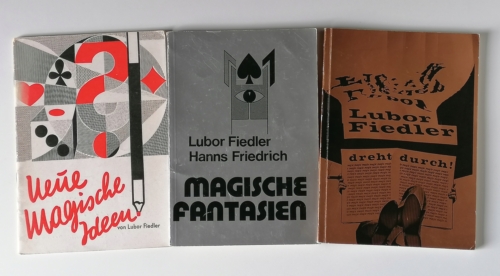 The attempt to publish a complete work proved to be more difficult than expected, even 36 years later. RICHARD KAUFMAN devoted himself to the commendable project of documenting LUBOR FIEDLER's legacy for posterity and announced that he was just completing an extensive Lubor-Fiedler book that would compile all of his ideas to date in a single volume: “The book will contain just about everything Lubor has published over the years. Everything that was in German has been translated, so now it's just a matter of editing that and adding all of his new material.” (Genii, 3/2014, page 76) That was seven years ago. While admirers of LUBOR FIEDLER continue to await the announced publication with great anticipation, RICHARD KAUFMAN lost interest in the project following LUBOR FIEDLER's interim death and has left it to CHRIS WASSHUBER, who is now working on completing the long-awaited Lubor-Fiedler book.
Two years after “Magical Fantasies”, LUBOR FIEDLER completed his trilogy with “Lubor Fiedler dreht durch” (“Lubor Fiedler Goes Berserk“, 1980, 104 pages). Although I would consider these three publications as his main literary work, they by no means represent his entire oeuvre, as there are still a number of journal articles, lecture notes, and other writings. In “Lubor Fiedler dreht durch”, LUBOR FIEDLER consciously uses his unique trait as a creative genius for his appreciative readership and clearly states on page 7 that he intends to provide impulses for the future with some of his inventions: “For those magic friends who have my book 'Magical Fantasies' on their nightstand and read a chapter from it every evening as if it were a novel, because this book contains some pieces that a conjurer would hardly perform under normal circumstances, I have prepared new such 'inspirations' and 'magician fantasies' in this book as well. Despite the sometimes fantastic themes, these contributions contain important food for thought that advance the art of deception, and so I hope that this time too they exhibit the often cited consistent fascination!” LUBOR FIEDLER refers here to “Frankenstein's Murder on Stage” (page 93), “The Wizard's Private Subway“ (page 99) and “Things That Disappear Against One's Own Will“ (page 88). Before we take a closer look at the latter text, let us briefly apply the motif 'disappearing against one's own will' to LUBOR FIEDLER himself: In literature, there are repeatedly references to his respective residence. For example, MICHAEL HITZEL writes in his 'Lubor Fiedler Nachlese' (1978) on page 1: 'In the years 1969 - 1974 Lubor Fiedler lived in Salzburg.' Or in Aladin 1/1998, page 12, under the heading 'Steps out of the Darkness', there is a note: '1967 emigration to Austria.' I have summarised several such literary references to provide a rough overview of the main places of residence of LUBOR FIEDLER. I assume that this timeline is not only incomplete but possibly also inaccurate, and am therefore always grateful for supplementary information. 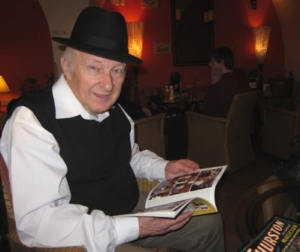 1933 - 1958 Brno
1958 - 1960 Karviná 1960 - 1967 Brno 1967 - 1969 Vienna 1969 - 1974 Salzburg 1974 - 2000 Spittal an der Drau 2000 - 2014 Brno Lubor Fiedler loses a card trick and gains an insight Under the heading 'Things that disappear against one's own will', LUBOR FIEDLER describes unintentional self-deceptions on page 88 in “Lubor Fiedler dreht durch” (1980) and points out their value in discovering new trick principles: “When it happens in life that one is faced with a puzzle, we are often close to a principle that could perhaps be used for our dear magic. Surely it has happened to you, for example, that you suddenly look for a small item in your own home that has gone missing, and you can no longer find it. Making something disappear or appear is the daily bread of every magician. Usually, one finds the object later while searching for something else, and realises that this principle is not useful. But there are cases in which one becomes very thoughtful and almost wants to believe in spirits.” As an example, LUBOR FIEDLER describes the initially inexplicable disappearance of a newly developed card trick that he had left on the shelf in front of the mirror and shortly afterwards could no longer find there. After an unsuccessful, extremely thorough search and several fruitless suspicions, he caught his pigeon some time later when coming home, rapidly flying from the mirror to the cupboard, where it usually sat in his presence. Apparently, whenever he left the room, it made short flights from the cupboard to the mirror, and now the suspicion arose that perhaps the draft from its wingbeats had knocked the packet of cards down. By pure coincidence, the wastebasket was below, which he had not yet searched, since he would never throw away his own trick himself... What others would dismiss in such a situation with a relieved “Damn!&lrrdquo;, LUBOR FIEDLER took as an opportunity to analyse the experienced deception in detail and study its course meticulously, with the intention of possibly discovering a new trick principle within it. Individual famous creatives have already expressed this thorough approach very aptly in the past. In “Zaubereien mit Pfiff – ohne Griff” (“Magic with Flair – without a sleight”, 1993) FRANZ BRAUN explains his motto on page 7: “You can make something out of anything”, which strikingly recalls the famous quote by DAI VERNON: “Never stop thinking.” Those who follow the advice of both, value everything and never stop thinking about improvements, can make something out of nothing and turn that something into a masterpiece. But what does it concretely mean to 'do something' and 'think about improvements'? It means the challenge of orienting oneself while growing in the stream of possibilities and sufficiently understanding its diverse course in order to further shape some of these possibilities. For example, the jumping rubber band by STANLEY COLLINS (“The Magician Monthly”, Issue 8/1911, page 10) is known today by everyone as an old hat – who has not seen the incredible routine “TRU” by MENNY LINDENFELD. Unfortunately, this milestone in trick development has so far only been circulated as a video and has not yet been published in print.  LUBOR FIEDLER lived for such peak moments, and he was an extreme non-stop thinker. Besides the world as it is, he perceived a second world consisting of possibilities of possibilities, understanding almost everything as a trick principle. However, this visionary superpower, for which he owes his worldwide fame as a genius, was not just amusing for him, but also demanded a lot from him physically and mentally, which we will address in the following third part of this series.
The joyful challenge of inventing only reaches its limits where the necessary personal resources eventually run out: health, safety, freedom, enthusiasm, confidence, and so on. In practice, far narrower are the limits set by less pleasant challenges, such as the commercialization of the acquired intellectual property, the struggle for social and artistic recognition, dealing with invisible hostilities, and unforeseeable disappointments. Although he always appeared friendly, modest, and funny, LUBOR FIEDLER was unpopular among envious magician colleagues due to his outstanding creativity and business independence. He seemingly had nothing with which one could boss him around. Thus, this sociable and prudent man was behind his back often labelled as a crazy professor by his so-called friends, and until after his death, he kept digging out the same anecdote about how he had to eke out a living as a refugee in Vienna by playing the eccentric piano in a coffee house: “Among other things, he had attached a horn to the piano ...” – in the misguided conceit that this would be a perpetual loss of status, that he had to work there for a tip while his arrogant nominal friends sipped their coffee. In contrast to such limited favour, I will conclude by describing a concrete example of the almost limitless joyful challenge of inventing, as well as of LUBOR FIEDLER's typical approach according to the inventor principles “You can make something out of anything” and “Never stop thinking”. In search of a new idea for Tenyo, where an everyday object was to be used, LUBOR FIEDLER chose a ballpoint pen and took as a starting point the magic wand trick “The Penetrative Wand” (Tarbell Course Volume 2, 1927, Lesson 21, page 67). Building on this, he worked on a penetration effect in which the ballpoint pen melts through another object. Next, he developed the idea of having the tip of the ballpoint pen protrude on the other side of the box, thus approaching the form that the trick would later take at its publication in 1995. The theme of invisibility fascinated LUBOR FIEDLER greatly, so he eventually changed the subject of the trick from a penetration zone to an invisibility zone. The gimmick principle of the support brace, which he newly developed for “Invisible Zone”, was later also used by LUBOR FIEDLER in his tricks “Phantom Clock” (1999) and “Ghost Corner” (2014), albeit in a completely different way each time. The trick motif of making the centre of a ballpoint pen invisible was absolutely new at that time and was successfully revived in the new millennium with “Reality Twister” (2002) and “Lubor's Lens” (2011). But the most original aspect of “Invisible Zone” is the spring that unexpectedly appears in the box. It not only enhances the effect of the invisibility illusion but also serves as a psychological distraction, because the spectator naturally believes this spring to be some technically necessary part of the device. Just as invisible as an 'Invisible Zone' is to us, the realm of inventors is often unseen, permeated with streams of possibilities full of potential and options. LUBOR FIEDLER has mastered the challenge of understanding this world and has brought us from there a rich treasure of inventive principles into the narrow confines of our practical reality. top deutsch 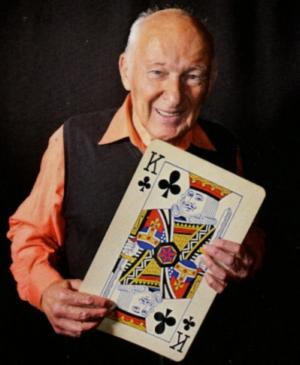 (Magie 10/21, page 502: “Trickprinzipien sind eigenständige Kunstwerke”)
Lubor Fiedler – inventing to createFranz Kaslatter In addition to desirable further artistic achievements such as prop-making and staging, a magic performance necessarily combines at least three different works of art: the invention, the routine and the performance. The performing artist should receive applause for the performance, and the creator should receive fame for the routine. But what should the inventor of the trick principle, on which it all relies, receive? The routine, the performance, the prop, the staging, etc. – all these works of art could only be created thanks to the invention, the fundamental artwork of every magic trick. Most magicians prefer to evade this question widely, feeling clever as if they had just successfully hidden from the television licence collector. And if they cannot evade it? Then, for example, the following happens: On 16 July 2016, a select group of magicians sat in the lecture hall of the Hamburg Museum of Ethnology to celebrate the 65th anniversary of the magazine 'Magische Welt'. WITTUS WITT hosted a lively panel discussion on the topic 'Magic: Yesterday and Tomorrow', when FLIP HALLEMA unexpectedly spoke up from the audience and brought up the subject of inventing, which, in his painful experience, is regularly ignored when magicians talk about their art. He had held a workshop the previous day and a lecture on the same topic that day and now passionately expressed his wish that in the magic community people would also talk about the inventors. However, not a single one of the high-profile attendees was willing to oblige him by commenting on it before the general shock passed and the next panelist quickly changed the subject. But before that, FLIP still received a very big applause. Mind you: he wanted nothing more than to have an open exchange of ideas about inventing in the most suitable discussion group imaginable – and that was clearly asking too much. Why didn't I speak up in this situation? Well, among other things, I was there on a mission to write a report for the Aladin, and I was just snapping a few blurry 3D photos of FLIP as he leaned over the railing of his row of benches, stretching his arms wide in an effort to reach the fellow magicians with his request. Don't ask me why everyone else just sat there silently, but I'm convinced they had a good excuse too. LUBOR FIEDLER would probably have agreed with FLIP, even if he himself might not have expressed himself so spontaneously in public. Rhetoric was not one of LUBOR FIEDLER's strengths, especially in German, and one repeatedly got the impression that he was basically uncomfortable with promoting himself. He addresses this in Aladin 1/1998 on page 14 under the heading 'The Thought World of a Magic Trick Inventor': “Magic trick inventors are not opinion makers – most of the time they communicate with the magical brotherhood only through their inventions. And that is actually very little when one considers how extensive the structures are in which new magical ideas emerge.” These extensive structures are mostly practical and commercial matters in the present, while the inventor creates potential and options for the future with new trick principles. This is also why the common evaluation criteria (usability and fun factor) often miss the actual usefulness and value of inventions, which largely lies not in a currently marketed product, but in the yet undiscovered potential for future applications. 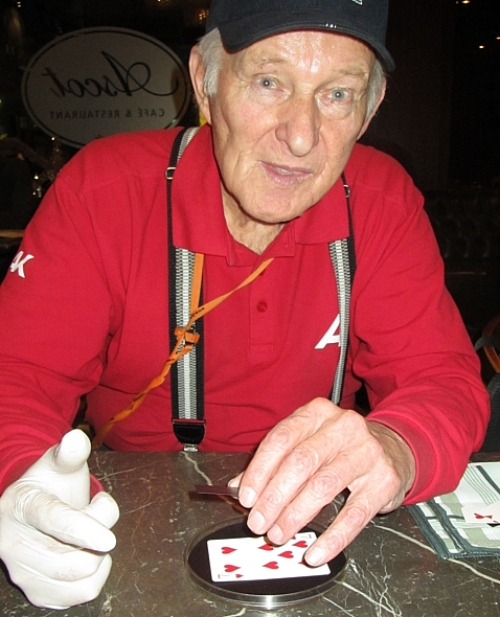 Further written evidence for this future orientation can be found with LUBOR FIEDLER. In “Magical Fantasies” (1978) on page 86, for example, he begins under the heading “The Future Visions of the Brain Centre of Magic” his report on the developmental status of some of his innovations with the following suggestion: “In the literature on magic, one finds plenty of material about the past and present, but rarely anything about the possibilities of magic in the future. However, it would certainly be a worthy topic for a scientific study. I do not intend to contribute such a paper here, yet I will indicate some ideas which will be pioneering in the field of magic.&rquo;
This focus on the future is essential because the benefit and value of inventions lie primarily in their future applications and only to a minor extent in the already executed, currently known implementations. From the first part of this series, we know that the purpose of inventions is the trick principle that enables the ploys on which a magic trick is based. In his world of potentials and options, the inventor creates a stream of new possibilities with each trick principle, and it is precisely these possibilities and their further development as options that are the essence of inventing, rather than their individual implementation. Principles of tricks are like a fungus that lives in the forest floor and repeatedly pushes its fruiting bodies to the surface. The layperson only sees these mushrooms, but does not take notice of the actual fungus. In the preceding second part, we dealt with the challenges and limits of inventing. To continue with our figurative comparison: the challenges of inventing include the fact that inventions are usually perceived solely in terms of their immediate use, just as if one were only to acknowledge the fruiting bodies of a fungus. The limits of inventing, however, lie in the limits of the spread of possibilities, and these are as unimaginably vast as the way a fungus spreads in the forest floor. Tricks principles are independent works of art. Their true utility and value is, by definition, substantially greater than any single trick that relies on the ploys enabled by this principle, because the value of a trick principle is at least as high as the total value of all tricks based on it, including all future ones. Usually, a judgment is hastily made about a single trick, without separately considering the ploys it relies on and without appreciating their respective trick principle as an independent work of art, which will very likely enable a multitude of other tricks in the future. A prime example of this misunderstanding was provided to the magic scene two years ago by the German collectors. Lubor Fiedler is ridiculed and yet laughs in the end On 09.02.2019, MICHAEL SONDERMEYER received great laughter with his contribution at the collector and chronicler meeting in Appelhülsen, which he called “The extraordinary principles of Lubor Fiedler.” I believe I know MICHAEL SONDERMEYER well enough to rule out that he wanted to bluntly make fun of LUBOR FIEDLER, but despite all the cheap amusement over the oh-so-extraordinary principles he presented, he unfortunately failed to convey their actual usefulness and value to his professional audience, leaving them with the confirmed prejudice: ingenious, but useless. 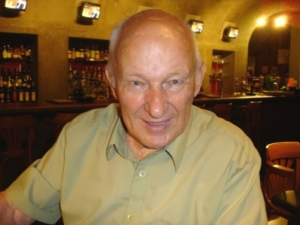 VERONIQUE FABER, apparently not a magician performing directly in front of an audience, felt after this meeting capable and compelled to judge very specifically in Magische Welt 2/2019 on page 65: “Although his tricks were not always suitable for performance, as the effect could only be seen from a certain angle, &hillip;” In Magie 8+9/2019 on page 422 ANDREAS FLECKENSTEIN tried in vain to do his best to sound somehow appreciative even regarding the facts: “&hillip; some absolutely impractical, but all the more curious ideas were presented.” This is what happens when well-meaning people take a look at LUBOR FIEDLER, which unfortunately remains superficially shallow by a decisive margin. In conclusion, I will report to you what happens when the respective people are not so unreservedly well-meaning.
But first I need to explain two things without which you will not be able to understand what follows. If you are very attentive, you may have noticed in the first part of this series the ten-year gap between the two Tenyo products Blue Crystal (2000) and 4-D Surprise (2010). In fact, at the beginning of this millennium, LUBOR FIEDLER did not invent anything for an entire decade, as he needed the full capacity of his mind to deal with a health challenge he called his 'Destiny Shock'. This darker side of his giftedness, the ability to associate every conceivable connection and imagine even seemingly far-fetched possibilities, had burdened him since earlier years in the form of severe emotional disorder, accompanied by depression, heart problems and paranoia, which became increasingly life-threatening from the year 2000 onwards. After doctors had treated him in vain for years and had nearly given up, LUBOR FIEDLER managed, through sheer willpower, to overcome this suffering himself by analysing his entire life in detail and focusing very persistently and consistently on the positive aspects, such as times when he was particularly happy. For the purpose of this successful self-salutogenesis, which spanned a total of two years, he invented his own mental aid: his 'beautiful mirror'. I find it easy to consider this invention his most important and ingenious, which is why I hold him in the highest esteem. “It was the circumstances of my life that made me ill”, he later explained, “And it was me being able to understand it that helped me work trough my problems and regain my health.” (Genii, Issue 3/2014, page 75) – He who laughs last is the architect of his own fortune! As is well known, we live in a 'post-factual' era, and the audiovisual media today are so coarse in content and form that a very conscious reflection is required to understand the scandal in the magic scene at the time, which was triggered in 2000 by the television programme “Die Zauberfamilie” ('The Magic Family'). Although twenty years ago one could generally rely on a TV team to respect the facade of an upstanding citizen and make them look good on television if they agreed to an unpaid TV appearance, there were also programmes that deliberately and explicitly lacked this usual consideration, but only to an entertainingly acceptable extent, with a lot of sensitivity, subtle irony and impeccable style. A prime example of this at the time was the series “Am Schauplatz” ('At the Scene'), which offered interesting social reports and milieu studies, and one of the first programmes in the series was 'The Magic Family'. This half-hour report offers a rough and very incomplete overview of the complex Austrian magic scene, depicted as a curious parallel world full of shy apprentices, bizarre inventors and eccentric presidents. At that time, there were half a dozen official magic clubs in Vienna alone, yet the programme almost exclusively targeted the club 'Zauberkistl' by name and exposed its president PETER MARES in all – including private – details. In between, for three minutes, the distinguished Austrian inventor LUBOR FIEDLER also comes under scrutiny. He is portrayed as particularly eccentric, and his workshop denounced as a garage “crammed full of magic tricks from top to bottom. Now, shortly before retirement, he doesn't know what to do with all the stuff.” Lubor is well off, as his tricks are produced by a large Japanese company and sold worldwide. The reporters at Schauplatz speculate that he can now live comfortably off the royalties, while at the same time offering no artistic praise for LUBOR FIEDLER: “Such ready-made tricks may excite the masses. Anyone who wants to be taken seriously by the real magicians needs to be able to do more. ”  By today's standards, it is hardly imaginable how offensive and inappropriate this report was perceived at the time and how incompetent some protagonists must have appeared in dealing with the media, having trusted in positive coverage but being presented in the worst possible light due to the then exaggerated and inappropriate sensationalism of this TV team. Twenty years ago, such perfidy was not a feather in anyone's cap, and the programme is still notably absent from some “Schauplatz“ listings. In direct comparison to current social reports, however, one would have to give the “Magic Family” credit for a commendably subtle approach, as there is little in the way of outright incitement, mostly relying on a tendentious use of quotations, and in my opinion, from today's perspective, no one should feel ashamed of such a television appearance.
However, contemporaries felt completely differently, as mentioned. Evidence of this can be found in Magie 12/2000 on page 451, where WOLFGANG SOMMER, in his column 'The President Reports', expresses indignation from afar about the conditions in Austria: “In mid-November, at the TV channel SAT3, I happened to see a first-class promotional film for non-membership in a magical association (&hillip;) a TV production from Austria titled 'The Magic Family'. (&hillip;) Comment by journalists Heide Lackner and Ludwig Ganter: Intrigues, conflicts and breakaways are no rarity in the magic scene of Austria. Anyone who wants to become president just leaves and starts a new club.” When WOLFGANG SOMMER wrote these lines, he of course knew very well that such things also occur in MZvD (Magic Circle of Germany). But for me, a completely different detail is particularly interesting, which he only casually mentions – namely, that LUDWIG GANTNER (known as a magician under the stage name MECKI) was a significantly involved journalist, as is clearly stated in the opening and closing credits: “... a report by Ludwig Gantner and Heidi Lackner. “ That is why I spoke to MECKI at the Austrian Magicians' Congress 2008 in St. Pölten about it, and he explained there that he had actually nothing to do with this whole unfortunate TV documentary. He had merely made the editorial team aware of suitable interview partners. I took note of that without comment and now pass it on to you so that you can form your own opinion. LUDWIG GANTNER, as an ORF employee, witnessed all sorts of attempts to bring magic to television both in front of and behind the camera in various editorial offices. Years later, he wrote: “Most of the time, it did not succeed very well. I can assert with conviction: the chance that a magician will be truly satisfied with his performance on television is slim. ” (Aladin 2/15, page 62) I do not presume to draw a causal connection with these lines, but merely want to point out the chronological connection: Shortly after the broadcast of “The Magic Family”, the association Zauberkistl left the Magic Ring Austria (Austrian umbrella organisation for the art of magic) – and LUBOR FIEDLER permanently left his residence in Austria. During LUBOR FIEDLER's lifetime, unfortunately many opportunities were missed by his fellow magicians to celebrate him as one of our most treasured. However, the trick principles he revealed to us will continue to hold an unforeseeable flow of precious possibilities for all time, as long as we remember him. top deutsch 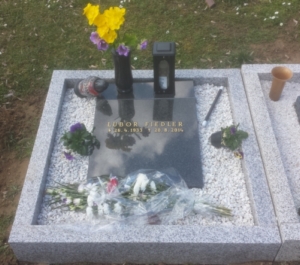 (Magie 10/21, page 504)
In Illustrious CompanyMemories of Jens-Uwe Günzel Lubor Fiedler's name is well-known in the magic industry. The visionary invented and developed countless fantastic creations in his seemingly inexhaustible memory. His clever and repeatedly astonishing tricks still mark his name today. For the Japanese magic brand Tenyo, he was a phenomenal genius in creating wonderful tricks and magic apparatuses. Today these are long considered collector's treasures and often fetch very high prices at auctions. When I published an obituary for Lubor in the October 2014 issue of Magie, it was a heartfelt need for me to remember a wonderful person and keep these “Memories of a Great Inventor” alive. For far too little attention was given to this extraordinary man in the German, indeed European, magic scene. I was quite surprised when one day in 2000 I found a letter from Lubor Fiedler in my post. That Fiedler, whom I knew not only from various good magic literature, his lecture notes, and above all through his many excellent creations from Tenyo. Our mutual friend Fred Sylvester first facilitated the contact, which eventually led to a lasting friendship. In this letter, Lubor also recalled many experiences with my great-uncle Kurt Soltau, who ran a well-known magic shop called Zauber-Soltau during the GDR era. He remembered visits to my birthplace Annaberg-Buchholz, but also meetings at the International Magicians Festival in Karlovy Vary (Karlsbad, then Czechoslovakia), not far from my hometown. He told me how difficult it was for Lubor at the time, who famously fled his homeland Czechia under cover of darkness, to be able to attend this international meeting in Karlovy Vary. As he was considered a state defector, the authorities in the CSSR were after him. It was only years later, through government relaxations, that it became noticeably easier for him to attend this well-known magician congress in Karlovy Vary. When I visited my Austrian friends Fred and Olly (2 Sylvesters) in Putzing, a small village of five hundred inhabitants in Lower Austria, in 2001, I was pleasantly surprised to be warmly welcomed by Lubor, as Fiedler was also visiting the two mutual friends at the same time. The following evenings with the Sylvesters in our illustrious circle were not only filled with intense conversations but above all with many magic performances. Lubor in particular displayed a passion for his creations, which seemed like true magic in his hands. He showed us his hits like the “Gozinta Box, ” which he had invented in 1966, and other classics from the well-known Fiedler workshop, such as the "Divided Hearts," as well as some of his famous tricks invented for Tenyo, for example Invisible Zone (1995), Impossible Pen (1997) and recent developments just launched on the market such as Phantom Clock (1999) and Blue Crystal (2000). He also said that he was already working on new things. He kept telling me the phrase: “Those who rest, rust, and I cannot sit at home on my sofa and wait for death…! He can wait a long time before he can get me, because I still have so many good magical ideas in my head!” He was especially interested in the Ore Mountains, which were well known to him; this was probably the key to our friendship. Both of us never felt like strangers, but rather connected – and not just in a magical sense. Lubor had only a few, but they were true friends. Too often he was disappointed and was therefore rather reserved in forming friendships. My friend Fred Sylvester once confirmed this to me, probably also to convey that I could feel honoured to be called a friend by Lubor. The time I spent with Lubor, Fred, and, of course, the enchanting Olly remains unforgettable to this day. Even after the death of our mutual friends, the two Sylvesters, the contact with Lubor remained very intense until his death. Lubor Fiedler's contributions to and in the art of magic are unique, and they deserve greater recognition for this great magical genius. Lubor Fiedler's contributions to and for the art of magic are unique and greater recognition is needed for this great magical genius and inventor. A significant step towards this is this special issue of Magie. top deutsch  (Magie 7/21, page 355)
A Gyro Gearloose of MagicHanno Rhomberg In my role as chairman of the MRA (Austrian umbrella organisation for the art of magic) I am grateful to Franz Kaslatter for such a personal reflection on the life of an artist who was so strongly connected to Austria. Lubor Fiedler is himself one of the most underrated magical geniuses in Austria. The general view that one must be a great performer to make a significant contribution to the art of magic is completely wrong. Numerous important figures in magic were not celebrated performers, but successful in other fields: inventors, historians, illusion builders or organisers have advanced the art of magic more than some trickster who entertains his audience with well-known effects. Both are needed in the wider family of magic. Lubor Fiedler was one of the most successful magical inventors we know. In doing so, he always looked beyond the obvious and was not afraid to be temporarily 'non-commercial'. In retrospect, however, many of his inventions were very commercial ... I have many memories connected with Lubor Fiedler. When I got into magic in 1977, Lubor Fiedler was a well-known name in Austria. His tricks were unique and unconventional, standing out from the uniformity of other magic acts. In my memory, he was an innovator of magical art. I rarely saw him perform, and when I did, it was less the entertainment that impressed me. Rather, the techniques he used to deceive were often better than the effect itself. Often, only after the explanation did one recognise the perfect and extraordinary thoughts of Lubor Fiedler. Two of his tricks bring back especially strong memories. I remember Combusto, which my magic friend Jürgen Peter and I tested in the living room. It was supposed to be some kind of illegal dangerous stuff, Jürgen said. I think today you probably wouldn't be allowed to sell this chemical, let alone ship it. But back then people were still carefree and did not shy away from using harmful chemicals for magical tricks. The same goes for Combusto: a liquid kept in a well-sealed small bottle, because if a drop was exposed to oxygen at room temperature, it would ignite within a short time. Jürgen and I used it in an effect shamelessly copied from punks to make a candle on a piano light itself. For this, we had to wrap the candle wicks in cotton wool and drip Combusto onto them 10 seconds before the curtain opened. It had to be done quickly, because when the curtain opened, you would see a piano with a candlestick that gradually ignited by itself. If the timing was off, the candles would already be burning before the curtain was open. The nice thing was that afterward the candlestick was completely unprepared and could be examined. Of course, we had to test exactly how long the ignition took, and so we ruined my parents' living room carpet, because every drop spilled during rehearsals would then ignite the carpet – a nightmare! Jürgen was banned from the house and we had to do our further experiments in secret &hillip; At the time, we had no idea that the two of us mischievous boys would later be active in roles at the Magic Ring Austria &hillip; (Ed. note: Jürgen Peter and Hanno Rhomberg have since each become chairman of the MRA) The other effect was the Gozinta box. A fantastic illusion that fascinated me from the very beginning. It is so strong that you need an intellectual audience for them to even understand the effect. One thinks of a secret mechanism, yet both cubes are completely unprepared. Presenting this effect well is very demanding. As simple as the presentation may be technically (some technique-obsessed people mistakenly call this self-working), the more challenging it is to find a suitable routine. I have performed many variants of this effect with rather modest success. First the 'Driebeck Die' by Bob Driebeek, a variant where the box transforms again at the end. Ken Brooke, as well as Mike Caveney, had a nice routine for it. Then I experimented with the close-up version from Tenyo, tinkered with the cubes myself, and finally ended up with 'Lubor's Gift'. Suddenly the box made sense to me, and I developed a routine for a lecture on illusion: A parcel is opened and inside you find a colourful box. In the box is then the prop with which you demonstrate a trick. To dispose of the packaging, you put it in the colourful box – a topological impossibility. After the next effect, you open the boxes again to find a new prop. As a running gag, with a prop appearing in the inner box each time, this routine is always repeatedly surprising and adds another layer of illusion. And so even today I think of Lubor Fiedler at every performance, whose brilliant mind we owe this and many other effects to. Sometimes a madman and tinkerer to outsiders, for us magicians who love subtleties and finesse, a genius. That he spent parts of his life in Austria makes us a little proud today. Although Lubor Fiedler is no longer alive, his ideas continue to live on and have amazed people all over the world for decades. Who can claim that about his magical life's work? Hanno Rhomberg Magical Ring Austria 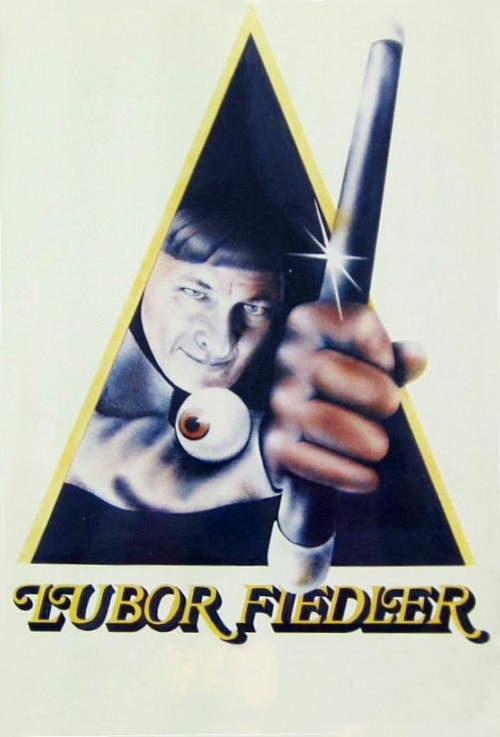 top
topdeutsch (Magie 7/21, page 352) Encounters with Lubor FiedlerTony Reisner Lubor Fiedler – a chaotic genius – extremely charming and always with a smile on his lips, that's how I got to know him, even though he was initially not doing so well financially. In 1979 he travelled back and forth between Vienna and Czechoslovakia, and we met 5 to 7 times a year for trick deliveries and to discuss his latest inventions. He always had new ideas with him, in his head or sometimes half-finished, which he presented to me, and some were very crazy! At that time he mainly made tricks such as “Brizzly Braze”, “20 Second Change Card” and the “Doodle Book”. His specialties and top sellers were the “Flying Color Cards”, “Contact X-ray Dice” and the “Cans with Time Delay”. Even the most experienced and best magicians could not figure out how these three tricks worked, and of course, they bought them eagerly. In our conversations, he told me that it takes him about 2 hours to make the 'Flying Color Cards' as he makes them by hand, armed with a utility knife. In the meantime, he sold easily performable packet tricks like the “Wild Card” to amateurs at a market stall in Vienna (Mariahilferstraße). Some Vienna magic clubs disapproved of this strongly, and as a result, he was something of an outsider for a while. During this period, he was also not doing particularly well financially, so he usually supplied us with more tricks than ordered to increase his earnings. For example, we ordered 12, he came with 15 and said, “I've just finished these!” Tirelessly, he tried to improve his existing tricks. Within 3 to 4 years, various plastic cases for the cube trick “Contact Röntgen Dice” were released until he had the beautiful dark brown case made, which was perfect and made him satisfied. His two books, “Magische Fantasien” from 1978 and “Lubor Fiedler goes crazy” from 1980, greatly increased his recognition in the magic scene, and our customers were always looking forward to new Fiedler tricks. Previously, only 3 booklets of his were on the market. The 'Automatic 2 Dice' (oil dice) was his biggest success at the time. It was repeatedly redesigned in appearance and size and is still offered today by many retailers under the name 'Die-A-Bolic'. 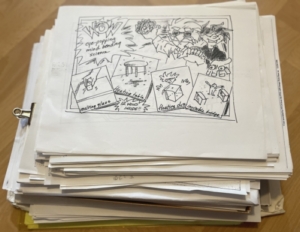 He also experimented a lot with chemicals. The tricks “Fire Flash”, “Glimmer Devil” or “Combusto” were extremely dangerous. In today's times, it would be unthinkable to offer these; the bomb disposal unit would probably be at the door. Back then, several dealers offered these powerful but risky effects, and in large quantities. I also suffered some minor fingertip injuries from the “Fire Flash” while demonstrating it in the store and at congress booths.
The trick that was probably the most baffling to me was the “Bang Bill” trick. A banknote, on which a glass stood, moved into the glass without any cover through a gunshot (without electronics). No matter how closely you watched, you saw nothing and were amazed that it worked. Lubor tinkered with this tray for a very long time until everything functioned flawlessly. The downside was that the gunshot was so loud that it startled everyone and drove some organisers to despair during demonstrations at trade fair booths at congresses. Even when we went to eat in a restaurant, he would play with a cigarette, trying to push it through the loosely woven tablecloth, which led to the trick “Master of Penetration“, where a cigarette penetrates the tablecloth. He was tireless when it came to turning ideas into various tricks. He even sold at some conventions himself, and when we sat together at night, he would create his card tricks during our conversation, which sold out so he could sell them again the next day. Sometimes he only slept 3 to 4 hours before being back at the sales stand. At a later meeting, he told me that he was negotiating with Japan (Tenyo company) and would be travelling there. The ideas he presented to Tenyo, which were then produced in large quantities, marked his big breakthrough. Yet he never became arrogant and had no star behaviour. His friendly manner and charming smile will always stay in my memory, and when the sky is misty and heavily cloudy, I sometimes think that Lubor is up there trying something new with smoke again! top deutsch 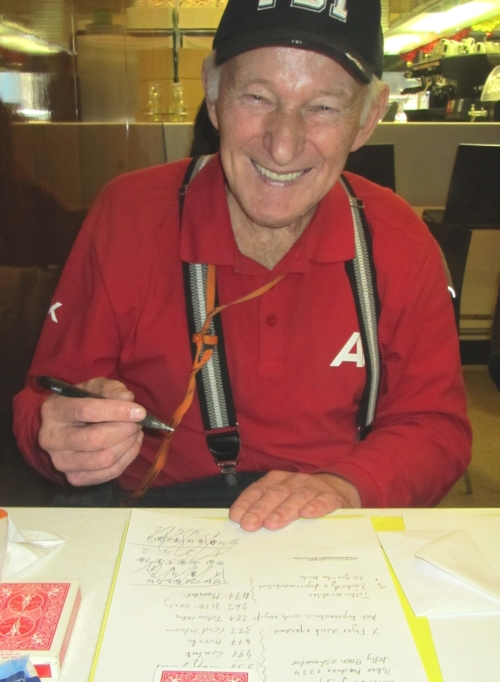 (Magie 8+9/21, page 436)
How we managed to prevent the Vienna fire brigade from being called at the last moment – and yet still got 'kicked out' of the venue …Michael Hitzel I shared a friendship with Lubor Fiedler that enriched me not only intellectually but in many other ways, allowing me to experience several adventures and highlights in magic. I met Lubor Fiedler in 1970 in Salzburg, shortly after my entrance exam for the local magic club. During my time in Salzburg, I visited Fiedler almost every day, and he often visited me, greatly appreciating my invitations for lunch or dinner at my home. He himself had only one room without a kitchen and usually sustained himself with sausage rolls and cold food. In the early days, he was in poor financial circumstances, so I helped him as much as I could, being young myself and just setting up my own household. Fiedler always lived very modestly. He financed his visits to inns with self-made card tricks that he performed in the tavern. I witnessed this many times. During his final years, he returned to his homeland, the former Czechoslovakia, and lived in Brno, from where he had originally fled. But he came to Vienna every few months, also to stock up on new material and above all chemicals, and we used these occasions to meet. He continued to invent new tricks, which he mainly offered to the company Tenyo in Japan. The challenge was that the tricks had to be new, but also commercially viable and inexpensive to produce. Of around 15 new ideas each year, Tenyo usually only took one or two, which were then, however, produced in large quantities. Fiedler spoke of quantities of around 50,000 pieces. Fiedler told me that the head of Tenyo personally travelled to Brno once a year to view Fiedler's new ideas and select those intended for production. Back in Japan, these were thoroughly tested internally, with production costs in particular having to be low. 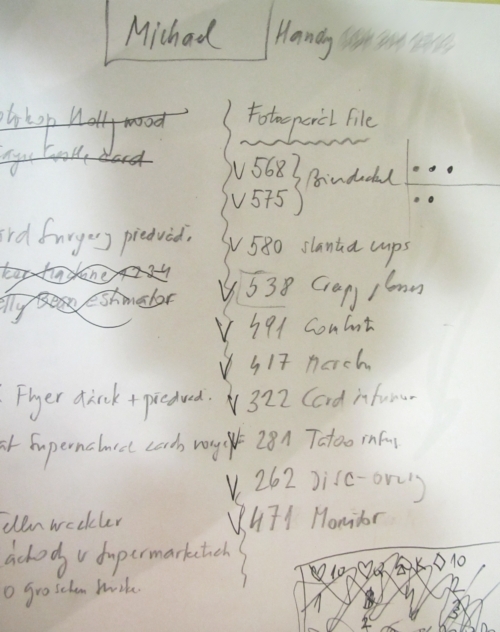 On these roughly biannual trips to Vienna, Fiedler always met me in the same restaurant on Mariahilferstraße, a very busy shopping street. The company “Duran Superimbiss” near the Zieglergasse U-Bahn station is a somewhat uninviting fast food place, but it offers tasty menus at reasonable prices, and it was only these low prices that Lubor Fiedler cared about. I don't find this plain restaurant appealing, but Fiedler greatly appreciated it and could not be dissuaded. He always brought a suitcase and bulging plastic bags full of new ideas to our meetings. On a handout, he had neatly noted the points of discussion, which he worked through with me. He showed me his new tricks in turn using the prototypes he had brought in their original state, asked for my opinion on the effects and for suggestions for improvement, and took notes. So I would arrive at a time before he offered these inventions to merchants for production or sale, already enjoying this particularly exclusive preview.
In addition to these novelties, Fiedler still had more surprises up his sleeve. In any case, there were flashes and smoke from his demonstrations at times, and on one occasion he really went too far. Fiedler was reprimanded several times by the manager to finally stop the “fireworks”, and I also asked Lubor to stop, but he was undeterred and carried on diligently. Then when a piece of fabric started to burn and it smelled terribly, the manager threatened to call the police and fire brigade and threw us out of the premises. We took a seat at a table outside the premises, and Fiedler enthusiastically continued. A larger crowd gathered on the passing sidewalk, which seemed to enjoy Fiedler's demonstration greatly, as they applauded enthusiastically. After a few months we were back in this restaurant, but this time without fire or threats involving the fire brigade. Fortunately, the manager was not there, who would probably have remembered the two gentlemen with the large suitcase and the smoking magic tricks. I myself still fondly recall this consistently exciting time with Lubor Fiedler. top deutsch 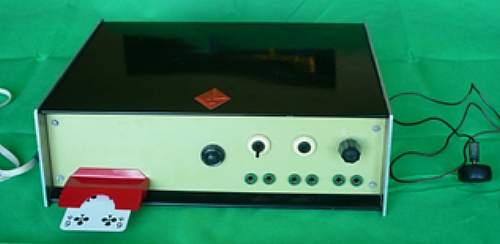 (Magie 10/21, page 507 )
An “Expedition” to Lubor FiedlerReinhard Müller I try to recall experiences from over 50 years ago, at the end of the 1960s. Even before I personally met Lubor Fiedler in Salzburg, I was familiar with tricks of his that appeared in the magazine Methodische Reihe Zauberkunst. At the time, Lubor Fiedler's “Eine fast unmögliche Münzenwanderung” (“An Almost Impossible Coin Transposition”) was highly valued in the “Society for Magical Art Salzburg”. We also had a dentist in the Salzburg club who obtained the dental dam for this trick, used in dental treatment at the time. The popularity of this effect is also evidenced by an article published years later in Magie, “Das Gummituch” (“The Rubber Cloth”), by the later president of the Salzburg club, Heinz Freundt. At that time I was fascinated by one of the astonishing graphical effects described in Zauberkunst, which I made myself: the “Negative-Positive Effect” with the word FILM. With my friend Otto Günther, then chairman of the Society for Magical Art Salzburg, I drove out along Moosstraße, which, by the way, is the longest straight road in the land of Salzburg, towards Untersberg. Far out, a short country lane led to an outbuilding of a farm with the house number 158, on the first floor of which Lubor Fiedler had his modest home. The Salzburg airfield was directly in view. This too had significance for Lubor. The theme of flying evokes two memories in me: once of Lubor's 2011 trick marketed by Tenyo, “Flying Carpet”, an effect that I interpret as a symbol for his later excursions to England and the USA and the experiences associated with them, and finally also for his return to Brno. Then I remember conversations that revealed Lubor's penchant for flying. To what extent he took advantage of the costly opportunities here in Salzburg, for example as a passenger, I can no longer recall precisely. In the late 1960s, there was not yet paragliding, which Lubor would later passionately pursue in Spittal, Carinthia. In any case, at that time in Salzburg he was in financial difficulties. 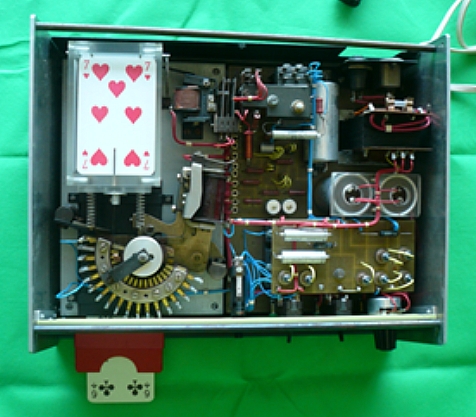 In this way I also came into possession of an expensive Fiedler unique piece, which he had used in his Czech television show. It is a 'playing card machine' that dispenses playing cards at timed intervals, not electronically, but 'classically' with electric and mechanical means (see illustrations!).
After reading the introduction of the club and its members in the special issue “Circle of Moravian Magicians Brno”, I can also explain how this card machine came about. Quote: “Some members, who are versatile artists and professionals with rich experience, help and advise the others. Mechanics, electricians, chemists and photographers accomplish a lot through collaborative work, and there are probably no magical props they could not create.” I also discovered this device in an illustration of his résumé in a detailed biography by Dustin Stinett in the American magazine GENII. Six stacked cards can be ejected from the device in sequence at adjustable time intervals. The device could also be remotely controlled via a cable. This device can thus be used for the basic effect of producing selected or imagined cards. In the picture above, to the right of the device, there is a black cable with a fake 'sensor' at one end, usable as a 'thought transference' aid: 'the spectator's thoughts shoot out'. Lubor also owned a second unique item, purchased by a magician friend from the Salzburg club. As far as I remember, it was a large (!) red die that could show the rolled number. Also notable and remarkable is the observation that Lubor devised many tricks with dice. In 1965 Werry marketed 'Lubor Fiedler's Dice Prediction' using a die standing on a corner in cover. We also saw with him the cube with a variable centre of gravity, as we called it, now known as 'Die-A-Bolic', or the cube without points, which appear from different angles ('Dice-Shoker'). I admired Lubor for how precisely he could handle plastics, the bonding of rubber sheet hinges (folding card with a chemical(!) time trigger), and how he knew how to turn them into magical implements. I am not an expert in packaging, so I am also amazed by the 'encasement' of his “Spielwürfel Automat” (with a variable centre of gravity) made from two symmetrically joined composite parts, which consist of a right angle with an attached equilateral triangle. Here, as with all the implements produced at that time, Lubor used the blue plastic base material from which he also produced, for example, the Lubor cube. Here we also admired for the first time the cube packed in a perfectly fitting box, into which Lubor could, on the other hand, force the box. I still remember exactly how he asked us, Otto Günter and me, what name he could give this feat of skill. We suggested the much-used name in German and translated into English, 'Lubor Würfel'! Edwin Hooper, owner of the Supreme Magic Company in Bideford, England, bought the rights in 1970 and marketed it as 'Lubor Die'. Jeffry Atkins from Southampton, England, introduced the name 'Gozinta Boxes' at an English convention in 1971, under which the effect became known worldwide. 'Parabox' is a close-up version released by Tenyo, Japan, in 1993.  Considering Lubor's creative thinking against the backdrop of the historical development of magic, it followed classical models in a modern context. Take a look at "magic" books from the 18th and 19th centuries and you will find “experiments and tricks with chemistry, electricity, mechanics, hydraulics, acoustics and optics. ” I also recall a curiosity demonstrating his agility in connection with Lubor at the 1970 FISM Congress in Amsterdam, where he participated with his Lubor cube in the Inventions category, unfortunately without success. Having not acquired a sales stand, Lubor sold his creations and was expelled from the congress. However, he did not give up and continued offering his props outdoors in front of the RAI-Gebouw congress building.
With one more peculiarity, I conclude my certainly fragmentary memories of Lubor Fiedler. I found a fitting anagram of “Lubor Fiedler”: “Loblieder Ruf” (Hymn call), and this call was heard. Just one example will be given here: I believe it is justified to include Lubor Fiedler in the exclusive circle of English-speaking personalities such as Terri Rogers, Robert Neale, Stewart James, Bob Hummer and Jerry Andrus, who were able to break out of established patterns of thought with a special gift and develop incredible magic tricks with those ideas. Reinhard Müller 25.04.2021 Pictures: Jens-Uwe Günzel, Michael Hitzel, Franz Kaslatter, Werner Liebig, Reinhard Müller, Tony Reisner and Mark Setteducati. |